YesNutri / Cardio and Body Health
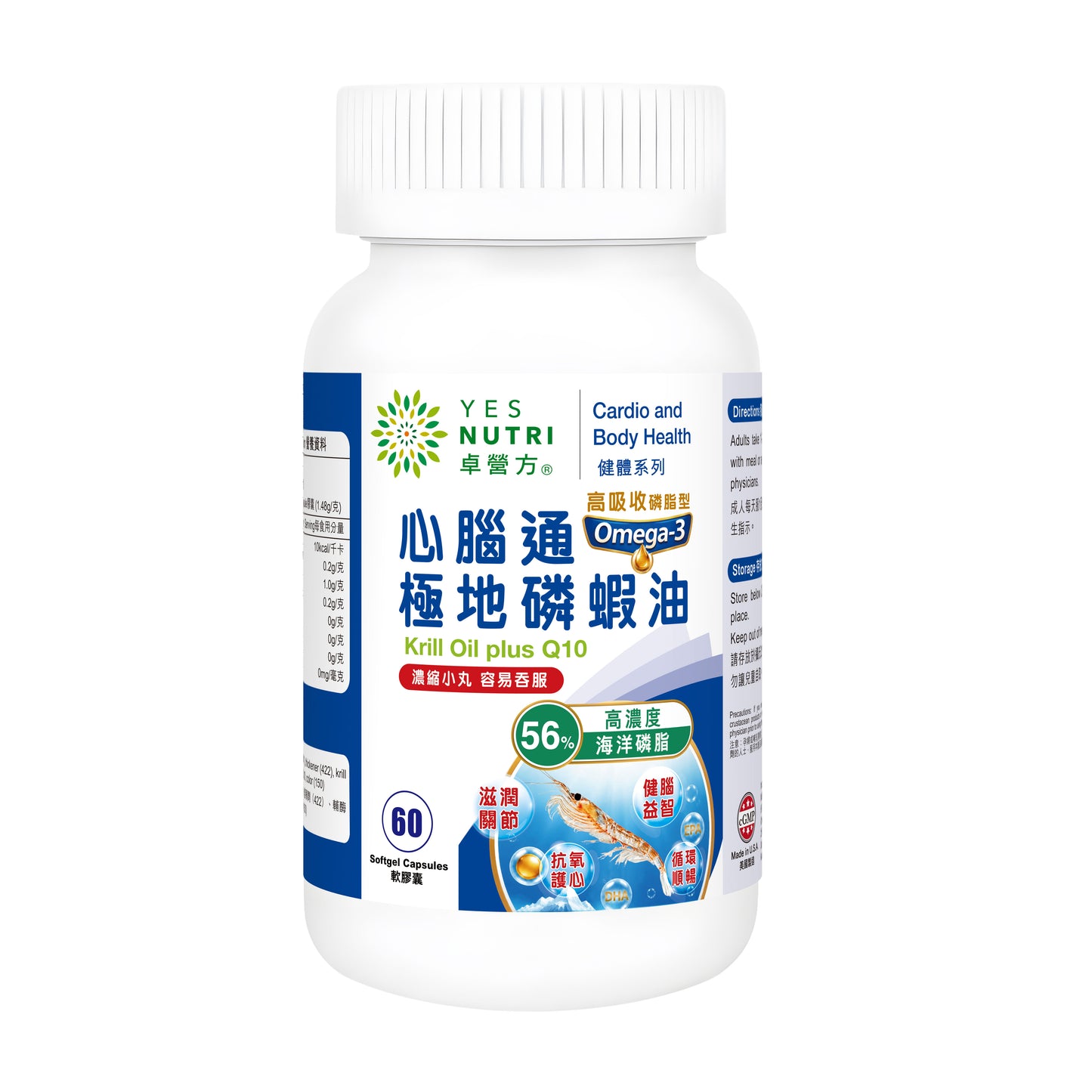
YesNutri Krill Oil plus Q10|Safeguards Heart & Brain Health
YesNutri Krill Oil plus Q10|Safeguards Heart & Brain Health
Couldn't load pickup availability
YesNutri Krill Oil Omega-3 plus Q10 is specially designed for fast-paced urban dwellers, with concentrated component, easy to swallow. Krill oil contains unique phospholipid-form Omega-3 penetrates deeply to support healthy heart and brain circulation, enhancing mental clarity and visual acuity. Coenzyme Q10 have potent antioxidants can activate cellular energy, boosting cardiac function and mental vitality. Provides comprehensive protection for cardiovascular, eye, and joint health, and keeps you at your best every day!
Composition:
Krill oil, Coenzyme Q10, Omega-3 fish oil

Pack Size: 60 Softgel Capsules | Place of Origin: America
Directions: Adults take 1-2 softgel capsules daily with meal or as recommended by your physicians.
Precautions: If you are pregnant, breastfeeding, allergic to crustacean products or are taking anticoagulants, consult your physician prior to using this product.
Storage: Store below 25℃ in a dry and cool place.
Keep out of reach of children.
Detailed Information
Krill Oil
Krill are small crustaceans resembling tiny shrimp, primarily found in cold oceanic regions such as the Antarctic waters. Feeding mainly on algae and occupying a low position in the food chain, krill oil is exceptionally pure and free from contamination. Krill oil provides abundant essential nutrients, including highly absorbable phospholipid-form omega-3 fatty acids (EPA and DHA), astaxanthin, 56% phospholipids, choline phospholipids, vitamin A, and vitamin E [1].
Astaxanthin is a natural potent antioxidant with an antioxidant capacity 500 times greater than vitamin E, also exerts anti-inflammatory effects by inhibiting the production of pro-inflammatory mediators, thereby mitigating inflammatory symptoms. Notably, astaxanthin can cross both the blood-brain barrier (BBB) to protect cerebral neurons and the blood-retinal barrier (BRB) to shield the retina from ultraviolet (UV)-induced damage and free radical oxidative stress [10].
Phospholipids are the principal structural components of cell membranes and are critical for preserving membrane integrity and functionality. Krill oil contains distinctive phospholipids; when omega-3 fatty acids are conjugated with these phospholipids, their bioavailability and cellular delivery efficiency are significantly enhanced. This phospholipid-bound form of omega-3 facilitates the maintenance of unobstructed vascular circulation, optimizes cerebral cognitive function, supports the health of the nervous system, and improves visual acuity [1, 2].
Phosphatidylcholine in krill oil are key components in synthesizing acetylcholine, a vital neurotransmitter involved in memory and cognitive function [11, 19]. They also support liver fat metabolism, help prevent fat accumulation, and protect liver health. Additionally, they are essential structural elements of cell membranes, contributing to overall cellular well-being [1, 2].
Omega-3 (EPA and DHA)
Both fish oil and krill oil provide EPA and DHA, which are beneficial polyunsaturated fatty acids that effectively regulate fat particles in the blood and maintain cardiovascular health [13]. Additionally, Omega-3 fatty acids offer the following benefits:
- Maintain cardio health [13]
- Preserve vascular elasticity and promote blood circulation [13, 18]
- Support brain health and enhance cognitive function [4, 17]
- Maintain nervous system health and improve vision [4, 5]
- Enhance memory and learning ability, supporting intellectual development [4, 17]
- Supplement the lipid layer of tear film to relieve dryness and irritation in the eyes [5, 16]
- Protect visual nerves and macular health [5]
- Alleviate joint swelling, pain, and stiffness [14, 15]
- Promotes anti-inflammatory factors, alleviating discomfort associated with premenstrual syndrome [20]
Comparison: Krill Oil vs Fish Oil
| Krill Oil | Fish Oil | |
| Absorption Rate | Higher | Lower |
| Omega-3 Form | Phospholipid form (High absorption, more directly utilized by human cells) | Triglyceride form |
| Additional Nutrients | Astaxanthin (Natural anti-oxidant component), 56% High Concentration Phospholipids, Phosphatidylcholine | None |
| Odor | No fishy smell | May have a fishy smell |
| Anti-oxidant Effect | Higher | None |
Coenzyme Q10
Coenzyme Q10 is a vitamin-like substance that the body can produce on its own and plays a crucial role in cellular energy production. However, as we age, the body's ability to synthesize coenzyme Q10 gradually declines. Coenzyme Q10 is present in most tissues of the body, with the highest concentrations found in the heart, liver, kidneys, and pancreas [2, 3, 7].
Coenzyme Q10 is essential for maintaining the function of mitochondria—the cell's energy factories—activating cellular energy metabolism and enhancing vitality. It also acts as a powerful antioxidant, neutralizing free radicals and protecting cells from oxidative damage [3].
The myocardium beats continuously every day, requiring its mitochondria to generate large amounts of energy to sustain cardiac activity, which can lead to oxidative stress. Coenzyme Q10 enhances the activity of superoxide dismutase (SOD), provides ample energy to the heart muscle, promotes blood vessel dilation, and supports cardiovascular health [2, 3, 7].
Benefits
- Supports heart and brain health [1, 2, 7]
- Improves circulation [1, 2, 7]
- Boosts energy and vitality [3, 8]
- Enhances mental clarity [1, 4]
- Maintains eye health [5, 9]
- Helps relieve joint discomfort [1, 6]
Suitable for
Concerned with cardiovascular and cerebrovascular health, Frequent mental exertion and high stress levels, Regular reading habits or extensive use of electronic devices, Smoking/alcohol consumption habits or frequent business social engagements, Prolonged sedentary behavior and insufficient physical activity, Dietary patterns high in fat and strong flavors, Middle-aged and elderly individuals, Women with premenstrual syndrome.
References
- Colletti, A., Cravotto, G., Citi, V., Martelli, A., Testai, L., & Cicero, A. F. G. (2021). Advances in Technologies for Highly Active Omega-3 Fatty Acids from Krill Oil: Clinical Applications. Marine Drugs, 19(6), 306. https://doi.org/10.3390/md19060306
- Tiano, L., Belardinelli, R., Carnevali, P., Principi, F., Seddaiu, G., & Littarru, G. P. (2007). Effect of coenzyme Q10 administration on endothelial function and extracellular superoxide dismutase in patients with ischaemic heart disease: a double-blind, randomized controlled study. European heart journal, 28(18), 2249–2255. https://doi.org/10.1093/eurheartj/ehm267
- Tsai, I. C., Hsu, C. W., Chang, C. H., Tseng, P. T., & Chang, K. V. (2022). Effectiveness of Coenzyme Q10 Supplementation for Reducing Fatigue: A Systematic Review and Meta-Analysis of Randomized Controlled Trials. Frontiers in pharmacology, 13, 883251. https://doi.org/10.3389/fphar.2022.883251
- Sinn, N., Milte, C., & Howe, P. R. (2010). Oiling the brain: a review of randomized controlled trials of omega-3 fatty acids in psychopathology across the lifespan. Nutrients, 2(2), 128–170. https://doi.org/10.3390/nu2020128
- Wang, H., & Daggy, B. P. (2017). The Role of Fish Oil in Inflammatory Eye Diseases. Biomedicine hub, 2(1), 1–12. https://doi.org/10.1159/000455818
- Ierna, M., Kerr, A., Scales, H., Berge, K., & Griinari, M. (2010). Supplementation of diet with krill oil protects against experimental rheumatoid arthritis. BMC musculoskeletal disorders, 11, 136. https://doi.org/10.1186/1471-2474-11-136
- Gutierrez-Mariscal, F. M., de la Cruz-Ares, S., Torres-Peña, J. D., Alcalá-Diaz, J. F., Yubero-Serrano, E. M., & López-Miranda, J. (2021). Coenzyme Q10 and Cardiovascular Diseases. Antioxidants (Basel, Switzerland), 10(6), 906. https://doi.org/10.3390/antiox10060906
- Katare, P. B., Dalmao-Fernandez, A., Mengeste, A. M., Navabakbar, F., Hamarsland, H., Ellefsen, S., Berge, R. K., Bakke, H. G., Nyman, T. A., Kase, E. T., Rustan, A. C., & Thoresen, G. H. (2024). Krill oil supplementation in vivo promotes increased fuel metabolism and protein synthesis in cultured human skeletal muscle cells. Frontiers in nutrition, 11, 1452768. https://doi.org/10.3389/fnut.2024.1452768
- Giannaccare, G., Pellegrini, M., Senni, C., Bernabei, F., Scorcia, V., & Cicero, A. F. G. (2020). Clinical Applications of Astaxanthin in the Treatment of Ocular Diseases: Emerging Insights. Marine drugs, 18(5), 239. https://doi.org/10.3390/md18050239
- Donoso, A., González-Durán, J., Muñoz, A. A., González, P. A., & Agurto-Muñoz, C. (2021). Therapeutic uses of natural astaxanthin: An evidence-based review focused on human clinical trials. Pharmacological research, 166, 105479. https://doi.org/10.1016/j.phrs.2021.105479
- Yang, Yu, et al. "Krill Oil Ameliorates Hepatic Oxidative Stress, Inflammation, and Fibrosis in Mice by SPARC-MAPK Pathway." Journal of Agriculture and Food Research, vol. 27, May 2026, p. 102746. https://doi.org/10.1016/j.jafr.2026.102746
- Magaquian, D., Delgado Ocaña, S., Perez, C. et al. Phosphatidylcholine restores neuronal plasticity of neural stem cells under inflammatory stress. Sci Rep 11, 22891 (2021). https://doi.org/10.1038/s41598-021-02361-5
- Liao, J., Xiong, Q., Yin, Y., Ling, Z., & Chen, S. (2022). The Effects of Fish Oil on Cardiovascular Diseases: Systematical Evaluation and Recent Advance. Frontiers in cardiovascular medicine, 8, 802306. https://doi.org/10.3389/fcvm.2021.802306
- Kuszewski, J. C., Wong, R. H. X., & Howe, P. R. C. (2020). Fish oil supplementation reduces osteoarthritis-specific pain in older adults with overweight/obesity. Rheumatology advances in practice, 4(2), rkaa036. https://doi.org/10.1093/rap/rkaa036
- Deng, W., Yi, Z., Yin, E., Lu, R., You, H., & Yuan, X. (2023). Effect of omega-3 polyunsaturated fatty acids supplementation for patients with osteoarthritis: a meta-analysis. Journal of orthopaedic surgery and research, 18(1), 381. https://doi.org/10.1186/s13018-023-03855-w
- O'Byrne, C., & O'Keeffe, M. (2023). Omega-3 fatty acids in the management of dry eye disease-An updated systematic review and meta-analysis. Acta ophthalmologica, 101(2), e118–e134. https://doi.org/10.1111/aos.15255
- Dighriri, I. M., Alsubaie, A. M., Hakami, F. M., Hamithi, D. M., Alshekh, M. M., Khobrani, F. A., Dalak, F. E., Hakami, A. A., Alsueaadi, E. H., Alsaawi, L. S., Alshammari, S. F., Alqahtani, A. S., Alawi, I. A., Aljuaid, A. A., & Tawhari, M. Q. (2022). Effects of Omega-3 Polyunsaturated Fatty Acids on Brain Functions: A Systematic Review. Cureus, 14(10), e30091. https://doi.org/10.7759/cureus.30091
- Colussi, G., Catena, C., Novello, M., Bertin, N., & Sechi, L. A. (2017). Impact of omega-3 polyunsaturated fatty acids on vascular function and blood pressure: Relevance for cardiovascular outcomes. Nutrition, metabolism, and cardiovascular diseases : NMCD, 27(3), 191–200. https://doi.org/10.1016/j.numecd.2016.07.011
- Barros MP, Poppe SC, Bondan EF. Neuroprotective properties of the marine carotenoid astaxanthin and omega-3 Fatty acids, and perspectives for the natural combination of both in krill oil. Nutrients. 2014;6(3):1293-317.
- Sampalis, F., Bunea, R., Pelland, M. F., Kowalski, O., Duguet, N., & Dupuis, S. (2003). Evaluation of the effects of Neptune Krill Oil on the management of premenstrual syndrome and dysmenorrhea. Alternative medicine review : a journal of clinical therapeutic, 8(2), 171–179.
Disclaimer: This product is not registered under the Pharmacy and Poisons Ordinance or the Chinese Medicine Ordinance. Any claim made for it has not been subject to evaluation for such registration. This product is not intended to diagnose, treat or prevent any disease.